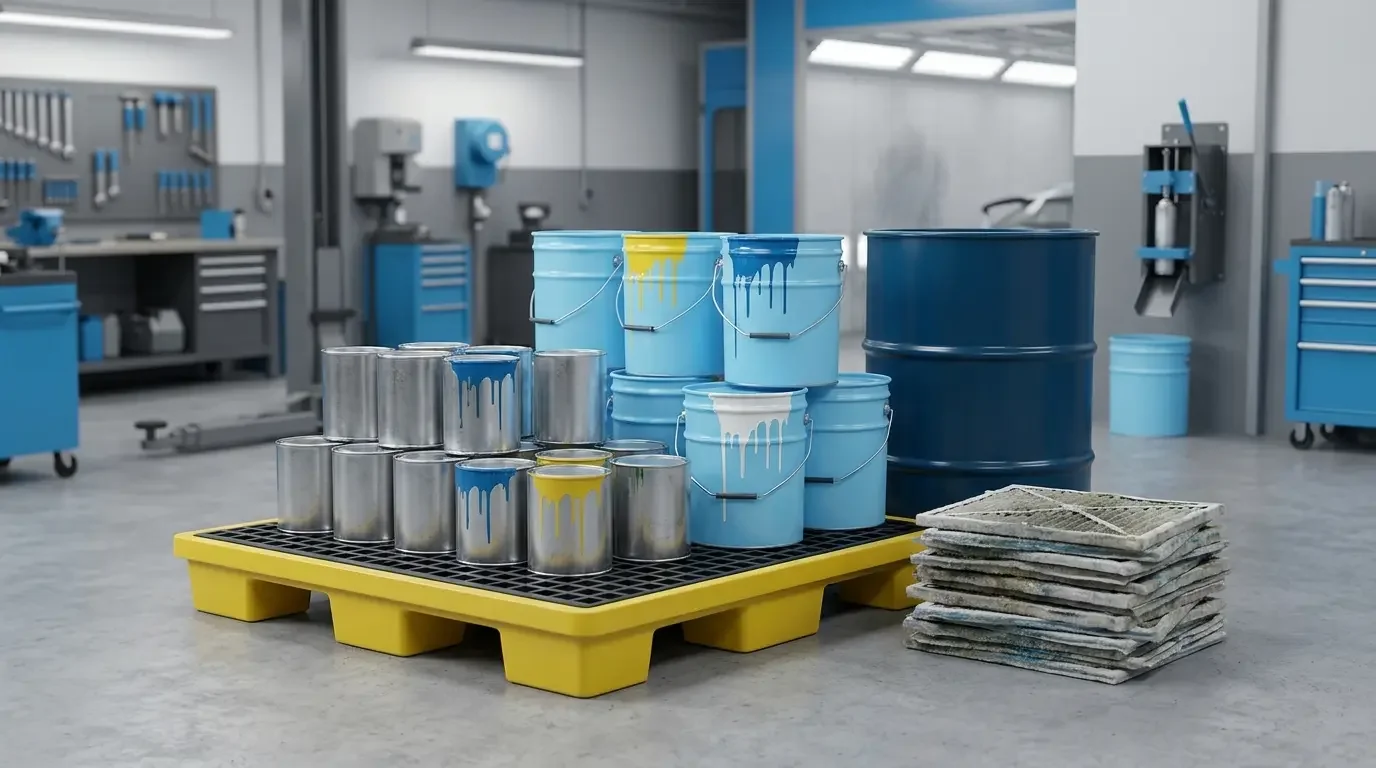
Paint waste shows up in more businesses than people expect. Contractors, manufacturers, auto body shops, property managers, schools, municipalities, and retailers all generate it. The streams are varied: leftover cans, thinners and cleanup solvents, spray booth filters, rags, sludge, and unsellable retail inventory.
Some of it is hazardous waste and some of it is not. The difference drives both compliance obligations and cost, so it is worth understanding before the next cleanout.
Oil-Based Paint and Coatings
Oil-based paints, stains, varnishes, lacquers, and many industrial coatings contain flammable solvents. When discarded, they usually exhibit the ignitability characteristic (D001). Some also contain heavy metals such as lead or chromium, which can trigger the toxicity characteristic.
Oil-based paint waste generally has to be managed as hazardous waste, counted toward your generator status, and shipped on a manifest to a permitted facility. Many of these streams are suitable for fuel blending, which is often one of the more economical disposal routes.
Thinners and Cleanup Solvents
Solvents used to thin paint or clean equipment are frequently listed hazardous wastes. Spent solvents such as xylene, toluene, acetone, and methyl ethyl ketone can carry F003 or F005 codes when used for these purposes, in addition to the ignitability characteristic.
Because of the mixture rule, mixing spent listed solvents with leftover paint or other wastes can make the entire mixture a listed waste. Keep solvents in their own containers and avoid combining streams for convenience.
Latex Paint
Water-based latex paint is generally not a hazardous waste under federal rules. That does not mean it can be poured down a drain or put into a dumpster in liquid form. Many local rules prohibit liquid waste in landfills, and some states regulate latex paint more strictly than the federal program does. California, for example, regulates latex paint as hazardous waste when discarded.
Options for latex paint include recycling programs, drying the paint before disposal where allowed, and consolidation for reprocessing. Check your state and local rules before assuming latex paint is unregulated.
Paint Stewardship Programs
A number of states have paint stewardship laws under which manufacturers fund collection programs for leftover architectural paint, often operated by PaintCare. These programs can accept certain volumes from businesses at no charge at the point of disposal. They are designed for leftover architectural paint, not industrial coatings, contaminated material, or large volumes, so check what is accepted before relying on them.
Paint-Related Material
Spray Booth Filters
Filters capture overspray and can exhibit hazardous characteristics, especially for solvent-based or metal-containing coatings. They need a waste determination, often supported by testing.
Rags and Wipes
Solvent-contaminated wipes may qualify for EPA’s solvent-contaminated wipes exclusion if specific conditions are met, including accumulation in closed, labeled containers and sending them to a qualifying laundry or disposal facility. Wipes that do not meet the conditions are typically managed as hazardous waste.
Paint Sludge and Still Bottoms
Residue from booth water, solvent recovery, and tank cleanouts can be highly concentrated and usually requires characterization before shipment.
Empty Containers
Paint cans that meet the RCRA definition of empty, meaning all wastes have been removed by normal methods and no more than one inch of residue remains, are not regulated as hazardous waste. Cans with dried paint are generally easier to manage than cans with liquid remaining.
Unsellable Retail Paint Inventory
Retailers and distributors may hold pallets of paint that cannot be sold because of tinting errors, discontinued colors, damaged containers, or expired products. These are full containers and can be large in volume. Oil-based and aerosol products in the mix need hazardous waste or universal waste management, while latex paint may have recycling options depending on the state.
Lowering Paint Disposal Costs
- Segregate oil-based paint, latex paint, solvents, and aerosols at the point of generation
- Buy only what is needed and reuse leftover paint where possible
- Use solvent recovery or recycling for cleanup solvents
- Manage aerosol paint cans as universal waste where allowed
- Use the solvent-contaminated wipes exclusion where your operation can meet its conditions
Handle Paint Waste Correctly
At hazwastedirect.com, paint waste projects are characterized by stream, routed to fuel blending, recycling, or treatment as appropriate, and closed with manifests and a Certificate of Disposal on every shipment.
Contact our team today for a fast quote and compliant hazardous waste disposal across all 50 states.