Aerosol cans are one of the most common hazardous waste streams in American businesses, and one of the most commonly mishandled. Paint, lubricants, cleaners, degreasers, adhesives, pesticides, and personal care products all come in aerosol form, and almost every facility has a box of partially used cans somewhere.
The good news is that federal rules now allow aerosol cans to be managed as universal waste, which is simpler and cheaper than full hazardous waste management. The catch is that the rules only help if you follow them. This guide covers how aerosol cans are regulated, when a can is actually empty, and when puncturing is allowed.
Why Aerosol Cans Are Regulated
A partially full aerosol can contains a propellant, usually a flammable gas such as propane or butane, and a product that may itself be hazardous. When discarded, cans often exhibit the ignitability characteristic (D001), and some contain listed or toxic constituents depending on the product.
Cans that are punctured, crushed, or heated in a compactor or dumpster can release propellant and cause fires. That is why aerosol cans cannot simply go into the general trash at a commercial facility.
Aerosols Became a Federal Universal Waste in 2020
EPA added aerosol cans to the federal universal waste program in a rule that took effect on February 7, 2020. Universal waste rules are designed for common, widely generated hazardous wastes, and they offer longer accumulation times, simpler labeling, and no manifest requirement for shipments between handlers.
Because universal waste rules are adopted by states individually, check whether your state has adopted the aerosol provision. A few states had their own aerosol universal waste rules before the federal change, and the details can differ.
Universal Waste Requirements for Aerosol Cans
- Accumulate cans in a container that is structurally sound, compatible with the contents, and able to prevent releases
- Label the container with “Universal Waste – Aerosol Can(s),” “Waste Aerosol Can(s),” or “Used Aerosol Can(s)”
- Keep cans no longer than one year from the date they became waste
- Be able to demonstrate how long the cans have been accumulated, such as with a start date on the container
- Store leaking or damaged cans separately in a closed, compatible container
- Train employees who handle the cans on proper handling and emergency procedures
- Ship to another universal waste handler or to a destination facility
When Is an Aerosol Can Empty?
An aerosol can that is empty under RCRA is not a hazardous waste and can generally be recycled as scrap metal. For an aerosol can, empty means the can has reached atmospheric pressure, meaning there is no propellant left, and it meets the standard for residues of the product inside.
In practice, a can that still hisses when you press the nozzle is not empty. A can that is clogged with product still in it is not empty either. Many businesses send all cans to a universal waste handler rather than trying to verify each one.
Puncturing and Draining
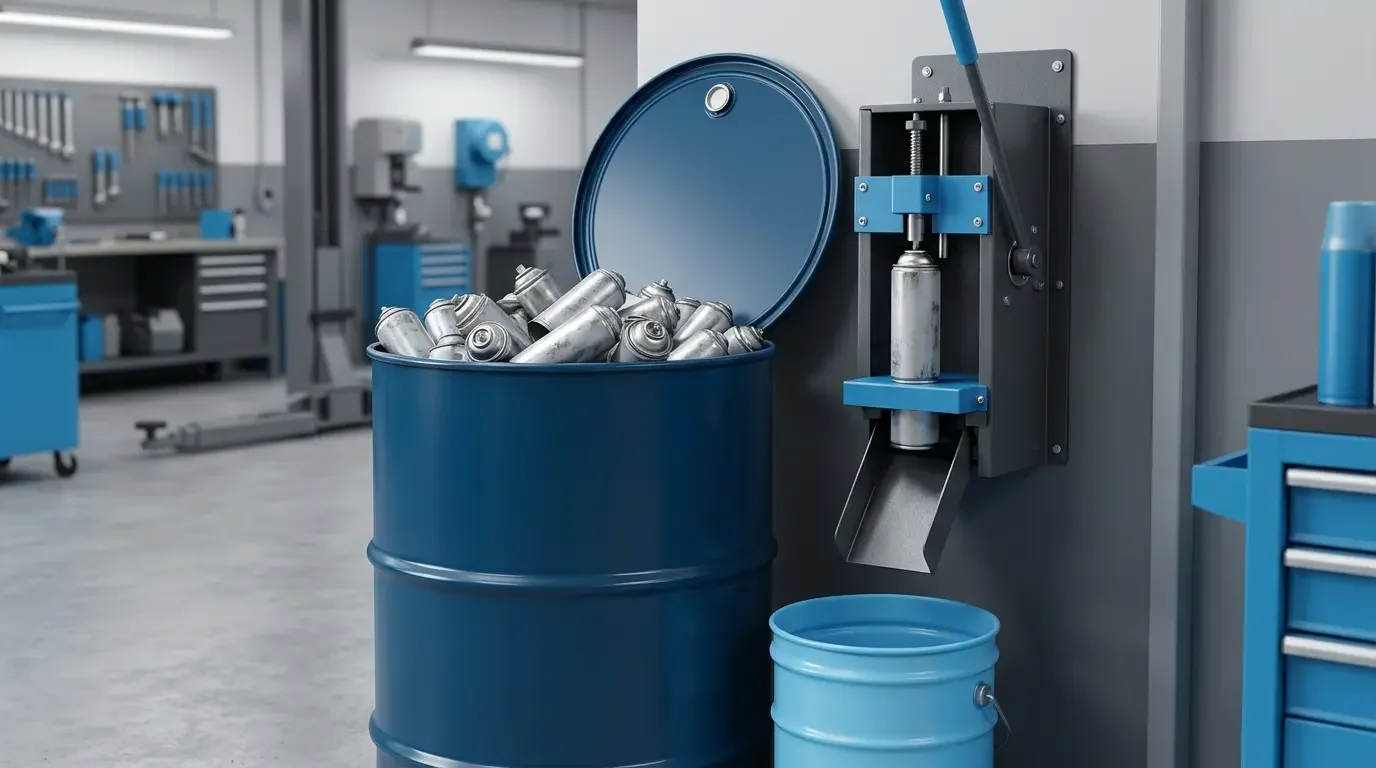
The universal waste rule allows handlers to puncture and drain aerosol cans, but only under conditions designed to keep the process safe:
- A device specifically designed to safely puncture aerosol cans and contain the residual contents and emissions
- Written procedures for operating the device, including safe operation, maintenance, segregation of incompatible wastes, and proper waste management
- A spill clean-up kit kept at the puncturing site, with spills cleaned up promptly
- Puncturing in a manner designed to prevent fires and releases, including in a well-ventilated area
- A hazardous waste determination for the collected contents, which often must be managed as hazardous waste
Puncturing can reduce volume and allow the empty cans to be recycled as scrap metal. It also creates a new waste stream, the drained liquid and propellant residue, which has to be characterized and managed on its own.
Ways to Lower Aerosol Disposal Costs
- Manage cans as universal waste where your state allows it, rather than as hazardous waste
- Buy in non-aerosol formats where the application allows it
- Use up products before replacing them, and centralize purchasing to reduce partially used inventory
- Keep cans out of general trash and compactors to avoid fires and violations
- Segregate unused retail aerosol inventory, which may have different routing than used cans
Unused Retail Aerosol Inventory
Retailers and distributors often hold large volumes of unused aerosol products that cannot be sold because of expiry, damage, or recalls. These are full cans with significant propellant and product inside. They can be managed as universal waste in many states, but the volume, packaging, and transport requirements are different from a box of used cans from a maintenance shop. Ask for a quote based on the actual inventory rather than a general rate.
Get Aerosol Cans Handled Correctly
At hazwastedirect.com, aerosol can projects are handled as universal waste wherever state rules allow, with compliant packaging, transport to permitted facilities, and a Certificate of Disposal on every shipment.
Contact our team today for a fast quote and compliant hazardous waste disposal across all 50 states.