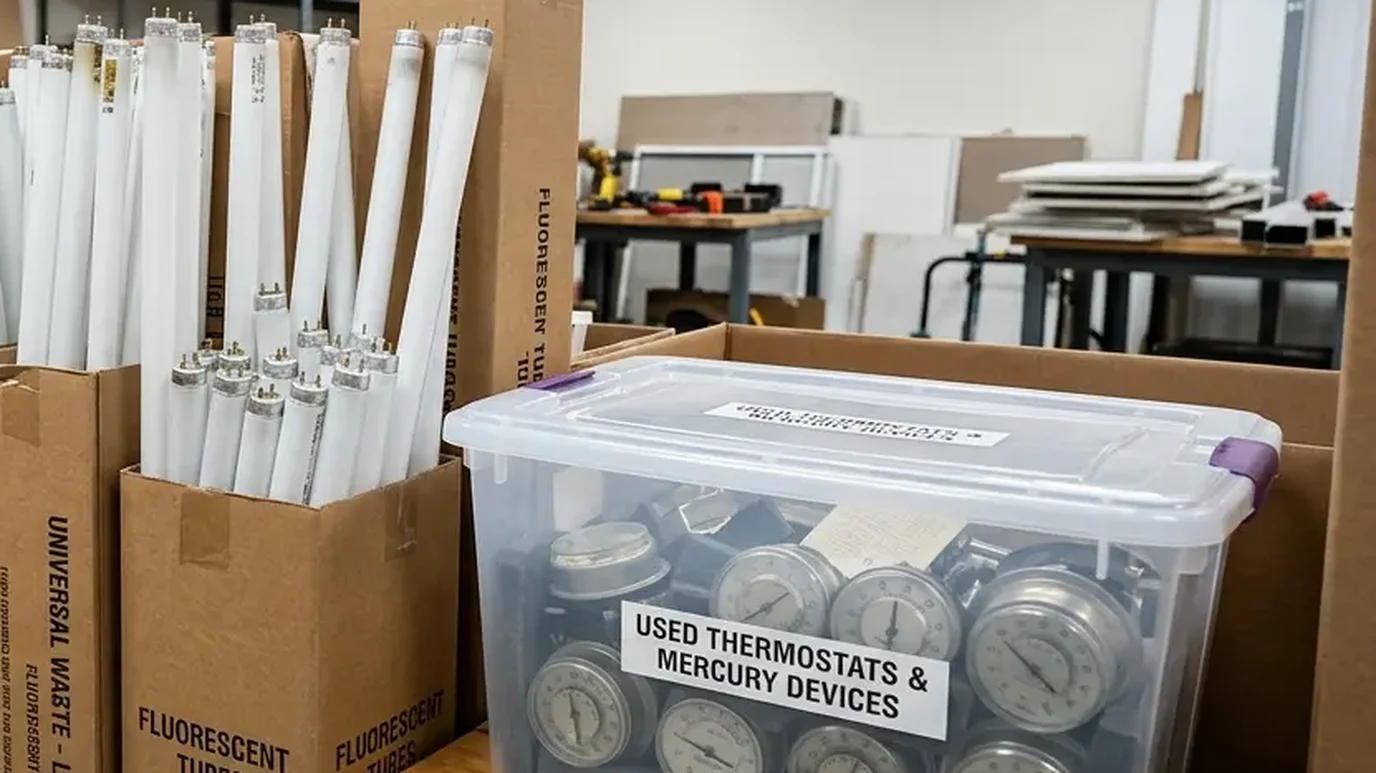
Mercury turns up across ordinary commercial buildings, mostly in places nobody thinks about. Fluorescent tubes, compact fluorescent lamps, high-intensity discharge lamps, older thermostats, tilt switches, manometers, thermometers, and some medical and laboratory equipment all contain it.
Lighting retrofits and building renovations generate large volumes of these items at once. This guide covers how mercury waste is regulated, how universal waste rules simplify handling, and what to do when lamps break.
Why Mercury Waste Is Regulated
Mercury is toxic, persistent, and accumulates in the environment. Waste that leaches mercury above the regulatory threshold in the Toxicity Characteristic Leaching Procedure, 0.2 milligrams per liter, is a characteristic hazardous waste with the code D009. Most mercury-containing lamps and devices fail that test.
That means these items cannot go into the general trash or a dumpster at a business, even in small quantities, unless they are managed under an applicable exemption.
Universal Waste Makes It Simpler
Federal rules allow mercury-containing lamps and mercury-containing equipment to be managed as universal waste. Universal waste handlers can accumulate items for up to one year, use simpler labeling, and ship without a hazardous waste manifest to another handler or a destination facility.
Lamps
Fluorescent tubes, compact fluorescents, high-intensity discharge lamps, neon, mercury vapor, and metal halide lamps are commonly managed as universal waste lamps.
Mercury-Containing Equipment
Thermostats, switches, relays, thermometers, manometers, barometers, and similar devices that contain elemental mercury can be managed as universal waste mercury-containing equipment.
States adopt universal waste rules individually and some add requirements. Several states prohibit landfilling of mercury-containing lamps entirely, even from sources that would otherwise be exempt.
Universal Waste Requirements
- Store lamps and devices in closed, structurally sound containers that prevent breakage
- Label containers, for example “Universal Waste – Lamp(s)” or “Universal Waste – Mercury Containing Equipment”
- Mark the date accumulation began, and ship within one year
- Train employees who handle universal waste on proper handling and emergency procedures
- Do not intentionally crush lamps unless your state specifically allows it under controlled conditions
- Ship to another universal waste handler or to a destination facility such as a lamp recycler
Broken Lamps
A broken fluorescent lamp releases mercury vapor and contaminated glass and powder. Clean-up should follow a written procedure:
- Ventilate the area and keep people away from the breakage
- Collect glass and powder with stiff paper or tape rather than a vacuum or broom
- Place debris in a sealed container
- Label and manage the debris as universal waste or hazardous waste, depending on your state rules
Large-scale breakage, such as a dropped box of tubes, should be handled by trained staff or a cleanup contractor.
Lighting Retrofits and Renovations
LED retrofit projects remove hundreds or thousands of lamps in a short period. Plan the disposal before the work starts, not after the old fixtures are already piled in a corner.
- Provide containers for the lamps before removal begins
- Assign responsibility for packing, labeling, and dating containers
- Remember ballasts: older magnetic ballasts may contain PCBs and need separate handling
- Keep lamp boxes intact and dry to prevent breakage in transit
- Record quantities removed so that disposal records match the project scope
Elemental Mercury and Equipment
Liquid elemental mercury collected from broken equipment or recovered from devices is regulated more strictly than intact devices. It should be stored in closed, compatible containers and shipped to a facility permitted to accept it. Do not consolidate mercury from multiple devices without understanding the applicable rules.
Documentation to Keep
Keep records of shipments, including quantities and destinations, for at least three years. Recyclers typically issue a certificate of recycling or disposal that confirms the items were received and processed. Keep this with your universal waste records.
Get Mercury Waste Handled Properly
At hazwastedirect.com, mercury lamps and equipment are packaged to universal waste standards, shipped to permitted recyclers, and documented with a Certificate of Disposal on every shipment.
Contact our team today for a fast quote and compliant hazardous waste disposal across all 50 states.