
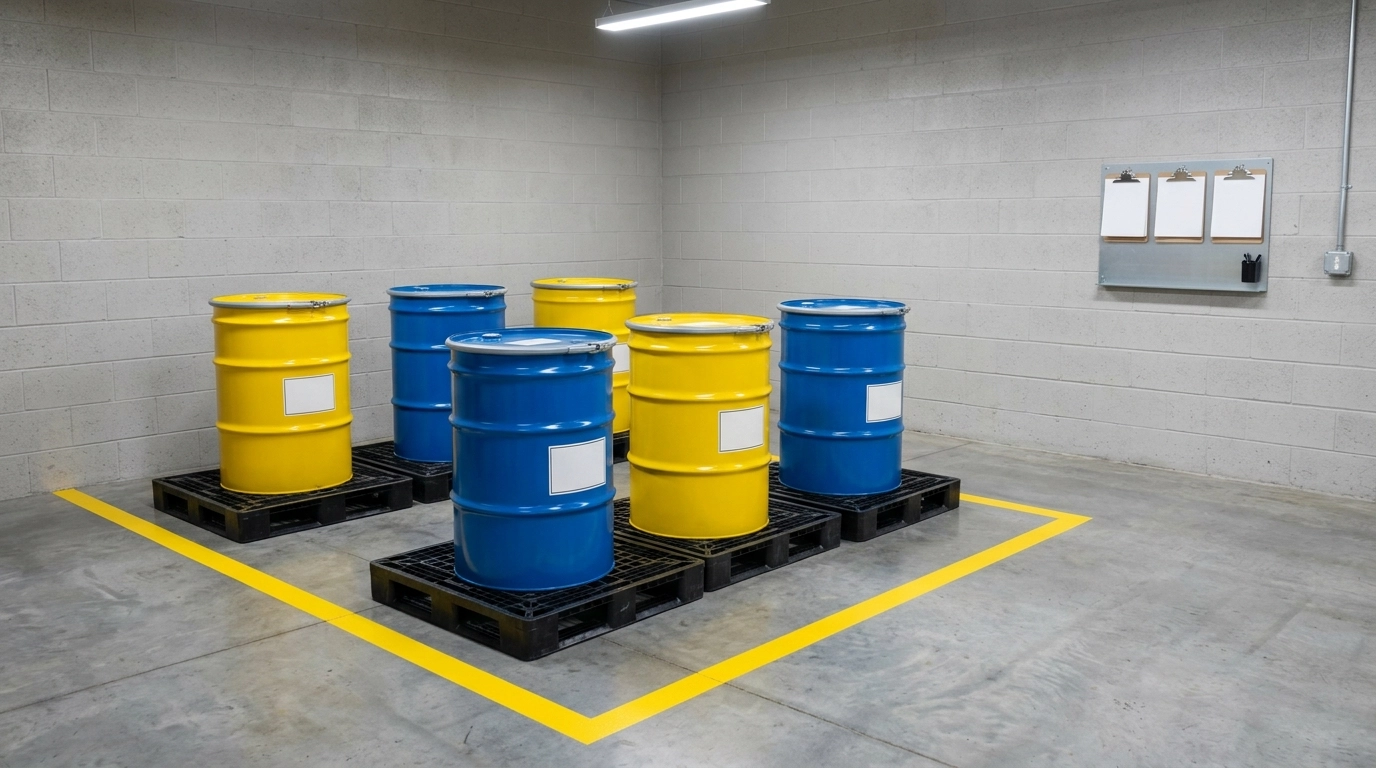
Accumulation violations are among the most frequently cited findings in RCRA inspections, and they are almost never the result of anyone deciding to break a rule. They happen because a drum sat two weeks longer than intended while somebody chased a purchase order.
There are two separate clocks running in most facilities, they work on different principles, and confusing them is where the problem starts.
Clock One: The Central Accumulation Area
This is the time-based clock, and it runs from the date accumulation starts in the container.
- Large quantity generators: 90 days
- Small quantity generators: 180 days
- Small quantity generators shipping to a facility 200 miles or more away: 270 days
- Very small quantity generators: no time limit, but a quantity limit on what may be held on site
A 30-day extension may be granted for circumstances beyond your control, but it is granted, not assumed, and it is not a scheduling tool.
Clock Two: The Satellite Accumulation Area
A satellite accumulation area sits at or near the point where the waste is generated and under the control of the operator running that process. It exists because some processes fill a container so slowly that a time limit would force you to ship half-empty drums.
This clock is quantity-based rather than time-based. You may accumulate up to 55 gallons of non-acute hazardous waste, or 1 quart of liquid acute hazardous waste, or 1 kilogram of solid acute hazardous waste, at any one time in an SAA. There is no day count while you remain under those limits.
What Happens When You Exceed the Limit
Once the threshold is crossed, mark the excess container with that date and move it to your central accumulation area within three consecutive calendar days. When it arrives, date it again, because that is when the 90 or 180 day clock begins.
The practical implication is that a large quantity generator effectively has up to 93 days from the moment the satellite limit was exceeded, and a small quantity generator up to 183. Those three days are not a grace period on the main clock, they are a transfer window.
Container Requirements That Apply in Both Areas
- Containers in good condition and compatible with their contents
- Kept closed except when waste is actively being added or removed
- Marked with the words Hazardous Waste and an indication of the hazards of the contents
- Incompatible wastes kept out of the same container and separated from each other
- Central accumulation areas inspected weekly, with the inspections documented
The closed container requirement generates more findings than any other single item, usually because of a funnel left sitting in a drum opening. A funnel is not a closed container, and a hinged lid resting on top is not a closed container either.
What Inspectors Look For
- Missing, illegible, or obviously back-dated accumulation start dates
- Drums past the applicable limit sitting in the accumulation area
- Open funnels and unsecured lids
- Satellite areas being used as informal long-term storage
- Multiple drums spaced along a wall to create the appearance of separate satellite areas
- Missing weekly inspection records for the central accumulation area
Let the Clock Drive Your Pickup Schedule
Schedule against the shortest deadline on your site rather than the average one. If one stream is on a 90-day clock, that is your operating cadence, regardless of how slowly the rest of your containers fill.
Book before the deadline arrives rather than on it. Capacity, transport, and profile approval all take time, and a compliant facility that finds itself two days from a limit has already lost most of its options.
Schedule Pickups Against Your Deadlines
At hazwastedirect.com, pickups are scheduled around your accumulation deadlines rather than a generic route calendar, with manifests, chain of custody, and a Certificate of Disposal on every shipment.
State rules can be stricter than the federal baseline, so confirm the limits that apply in your state. Contact our team today for a fast quote and compliant hazardous waste disposal across all 50 states.