Laboratory waste breaks the assumptions behind most hazardous waste programs. Industrial waste tends to be a few streams in large volumes. Lab waste is the opposite: hundreds of small containers, dozens of chemistries, incompatible materials sitting next to each other on the same shelf, and a meaningful number of containers nobody can positively identify.
The volume is small. The complexity is not, and that is what you are paying for.
Why Lab Waste Costs What It Does
Pricing for lab work is driven by container count and sorting labor rather than by weight. A single 55-gallon drum of a known solvent is a simple job. A drum built from ninety small bottles that have to be identified, checked for compatibility, segregated, and packed individually is a completely different piece of work.
This is why quotes for lab cleanouts vary so widely, and why a chemical inventory produces a much better quote than a photograph of a storage room.
What a Lab Pack Actually Is
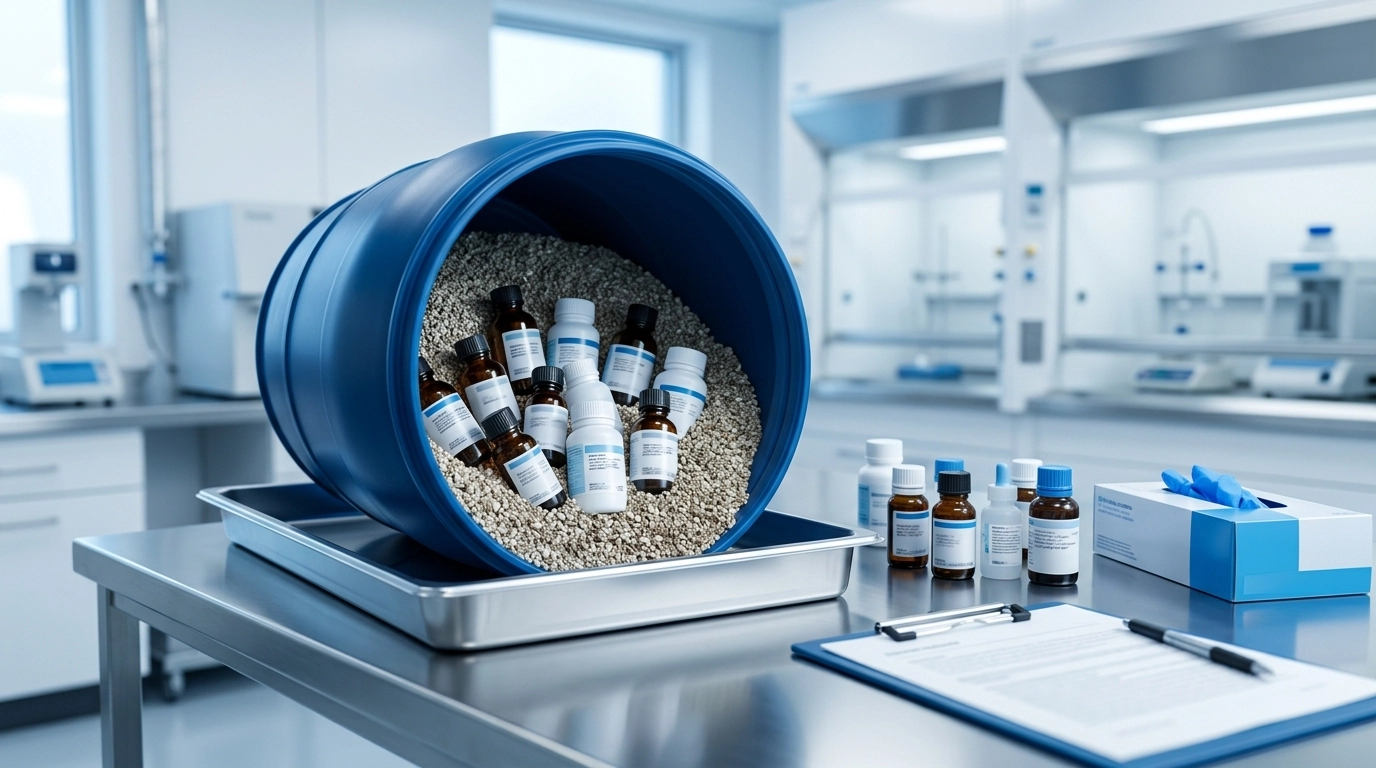
A lab pack is a larger outer drum containing many small containers, segregated by compatibility and cushioned with absorbent material sufficient to contain the contents if something breaks in transit. Each inner container is identified and listed on an inventory that travels with the drum.
The approach exists precisely because shipping several hundred individual small containers would be impractical. Segregation by hazard class is the core of it. Acids do not travel with bases, oxidizers do not travel with flammables, and cyanides and sulfides are kept well away from anything acidic.
Unknowns Are the Most Expensive Items in Any Lab
An unlabeled container cannot be shipped as an unknown. It has to be characterized first, at minimum enough to assign a hazard class and a compatible packing group, and that testing is charged per container. A shelf of twenty unknowns can cost more to clear than the rest of the cleanout combined.
The prevention is entirely upstream and entirely free. Label at the point of generation, with the chemical name written out rather than a formula or an abbreviation, plus the date and the person responsible. The cheapest unknown is the one that never gets created.
Peroxide Formers Deserve Attention Before They Become Emergencies
Certain chemicals form peroxides on exposure to air over time, including diethyl ether, tetrahydrofuran, isopropyl ether, and dioxane. As the material ages and evaporates, those peroxides concentrate, and in the worst case they become shock-sensitive.
The operational rules are simple and firm. Date containers when received and again when opened. Dispose of them within the recommended interval rather than when someone gets to it. And if you find a container with visible crystals around the cap or in the liquid, or an old container whose age you cannot establish, do not move it, do not open it, and do not put it in a lab pack. That is a specialist call, and it should be made from a distance.
Other Items That Need to Be Flagged in Advance
- Picric acid that has dried out, which becomes shock-sensitive when it loses its water content
- Old containers of any material where the age cannot be established
- Compressed gas cylinders, particularly lecture bottles and orphaned cylinders with no supplier to return them to
- Mercury thermometers, manometers, and other mercury-containing devices
- P-listed acutely hazardous chemicals, which count against a threshold measured in kilograms and can change your generator status
- Anything with a damaged, corroded, or seized closure
Preparing for a Lab Pack Pickup
- Build an inventory listing chemical name, approximate volume, and container type
- Segregate by hazard class in advance where it is safe to do so
- Identify unknowns, peroxide formers, shock-sensitive items, and cylinders and flag them separately
- Confirm access, including elevators, doorway widths, and where a truck can actually park
- Have someone available on the day who knows the space and the history of the material
An hour spent on an inventory beforehand routinely saves several hours of on-site sorting, and the on-site hours are the expensive ones.
Documentation
Each lab pack drum ships with its inner container inventory, on a manifest, with a Certificate of Disposal at the end. For research institutions and regulated laboratories, retain those records with your chemical hygiene and inspection documentation, since they get reviewed together.
Clear the Lab Safely
At hazwastedirect.com, lab pack services cover chemical inventories, compatibility segregation, unknowns characterization, and specialized handling for peroxide formers and shock-sensitive materials, with full documentation on every shipment.
Contact our team today for a fast quote and compliant laboratory waste disposal across all 50 states.